
ESD for Gastrointestinal Tumors
The technique of Endoscopic Submucosal Dissection (ESD) is a modern method used to treat early gastrointestinal tumors without surgery.
Gastrointestinal tumors progress through three stages:
1. Benign Tumors: Also known as colon polyps.
2. Precancerous Tumors: Classified into three grades.
3. Malignant Tumors: Classified into five grades.
The ESD technique allows for benign and adenomatous tumors, as well as grade 1 malignant tumor removal. The tumor is identified and removed from the superficial layers while preserving the deeper layers with safe horizontal and vertical margins, using high-quality endoscopes that assist in locating the tumor.
The procedure also involves the use of special tools to remove the tumor from the walls of the gastrointestinal tract with extreme precision. This technique enables tumor removal with minimal damage to the gastrointestinal wall, maintaining the integrity of the affected organ. The procedure requires high expertise and precision from Dr. Shaimaa El Kholy, Associate Professor of Advanced Interventional Gastrointestinal Endoscopy (ESD & Third Space Endoscopy), Faculty of Medicine, Cairo University.
This modern technique allows access to the gastrointestinal tract without any incisions, meaning faster recovery and less pain compared to open surgery. Therefore, most patients typically return home on the same day. After a successful procedure, the patient is completely free of the tumor and generally does not require further therapeutic intervention.
When is Endoscopic Submucosal Dissection (ESD) applied?
ESD can be performed to treat benign tumors, adenomatous tumors, and first-degree malignant tumors that involve the first three layers of the five layers of the gastrointestinal wall and have not reached the muscle layer, which is the fourth layer:
• Colorectal cancer.
• Esophageal cancer.
• Small intestine cancer, including duodenal cancer.
• Stomach cancer.
Symptoms of colon polyps or tumors:
• Rectal bleeding.
• Weight loss.
• Abdominal pain and bloating.
• Anemia.
• Changes in bowel habits, such as sudden constipation or chronic diarrhea.
• Sometimes, the tumor is discovered by chance and the patient does not complain of any symptoms.
• Anyone with a family history of fourth-degree relatives is at increased risk.
Preparation for Endoscopic Submucosal Dissection (ESD) of gastrointestinal tumors:
• For lower gastrointestinal procedures, follow a liquid diet with a laxative or enema to cleanse the bowels and ensure clear visibility of the colon and rectum.
• For upper gastrointestinal procedures, do not eat or drink for 12 hours before the procedure to ensure the esophagus is clear of food.
• If you are taking medication that affects blood clotting, ask when you should stop taking it and how many days you need to wait before resuming.
What happens during Endoscopic Submucosal Dissection (ESD) for gastrointestinal tumors?
1. The patient undergoes general anesthesia under the supervision of an anesthesia team to ensure he feels no pain.
2. Dr. Shaimaa El Kholy inserts a high-resolution endoscope, depending on the location of the tumor, through the mouth for upper gastrointestinal tumors or the anus for lower gastrointestinal tumors.
3. Dr. Shaimaa El Kholy monitors the images on a screen to study the tumor in terms of shape and details of the blood vessels supplying it, to avoid damaging surrounding tissues during the procedure.
4. The endoscope is guided to the desired location.
5. Dr. Shaimaa El Kholy determines the tumor location and marks its boundaries using a special tool passed through the endoscope, considering safe margins both horizontally and vertically.
6. The layer beneath the tumor is injected with a solution to separate it from the muscle wall, helping to minimize damage to surrounding tissues during the procedure.
7. A high-frequency electric knife is used to cut the tissue from the gastrointestinal wall. The electric current simultaneously cauterizes blood vessels, leading to their closure and thus reducing bleeding.
8. The tissue is removed from the body as a single piece via the endoscope and sent to the laboratory for analysis to ensure the tumor has been completely excised with safe margins, eliminating the need for surgical, radiological, or chemotherapy interventions.
9. The procedure takes between one to three hours.
10. After the procedure, the patient will be monitored in the recovery room until the effects of the sedative wear off.
Advantages of Endoscopic Submucosal Dissection (ESD) for Gastrointestinal Tumors:
• High-Definition Endoscope: It allows for precise visualization of gastrointestinal details.
• Using Carbon Dioxide: Instead of air, CO2 is used for insufflation during treatment, preventing gas, bloating, or cramping due to its high absorption capacity.
• Special Cutting Tools: These surgical knives enable the endoscopist to control the size, shape, and depth of the excised tissue.
What are the benefits of ESD Compared to open surgery?
The ESD technique provides multiple benefits compared to open surgery, including:
• Comprehensive removal of irregularly shaped tumors.
• Complete excision of large tumors that cannot be removed in one piece by other methods.
• Ability to remove tumors without clear borders.
• Control over the size and shape of the excised tissue.
• Preservation of the affected gastrointestinal organ, as only the abnormal growth and a small amount of surrounding tissue are removed, unlike surgeries that may involve removing parts of the esophagus, stomach, or colon.
• Reduced risk of cancer spread.
• ESD provides more accurate delineation of safe margins, making it effective for excising larger and more complex tumors.
• Less pain.
• Reduced risk of complications.
• No surgical incisions, serving as a safe alternative to traditional tumor resection.
• No scars.
• Faster recovery.
• Return to daily activities within a few days.
Who are the qualified doctors for Endoscopic Submucosal Dissection (ESD) for gastrointestinal tumors?
Endoscopic submucosal dissection for gastrointestinal tumors is performed by a gastroenterologist with expertise in interventional therapeutic endoscopy. ESD technique requires comprehensive education, training, technical skills, and experience. Dr. Shaimaa El Kholy, Associate Professor of Advanced Interventional Gastrointestinal Endoscopy (ESD & Third Space Endoscopy), Faculty of Medicine, Cairo University, is dedicated to mastering advanced endoscopic procedures. She has participated in numerous lectures and workshops across various countries, including England, the Netherlands, Austria, and China. Most recently, she received practical training for the first time in China, which enabled her to bring this modern technique to Egypt in 2018.
Before this date, patients had to wait for their only opportunity to access this technique, which was available once a year in workshops hosted by Cairo University with foreign experts, or they had to undergo surgical treatment and face all its complications.
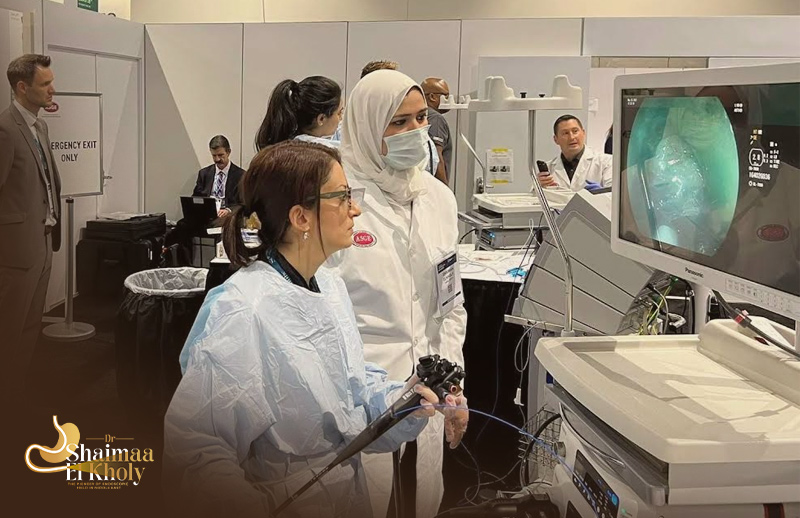
Dr. Shaimaa El Kholy was invited by the American Society for Gastrointestinal Endoscopy (ASGE), the largest global association in this field, to train doctors in tumor dissection at the largest international gastroenterology conference in San Diego, California, in 2022. Thus, Dr. Shaimaa El Kholy became the first Arab female doctor to receive this honor.