Learn about Third Space Endoscopes
Many may have heard of Third Space Endoscopes, but the precise meaning of this term may be unclear. While the first space is within the gastrointestinal tract and the second is in the peritoneal cavity, a third space endoscope focuses on the space between the third layer of the gastrointestinal wall and the muscle, representing the fourth layer.
Minimally invasive procedures have brought numerous benefits to patients, from reduced recovery time to decreased risk of infection, which advanced gastroenterology, particularly in endoscopy.
Third Space Endoscopy is a collective term for a range of endoscopic techniques that perform diagnostic or therapeutic functions, or both, safely, effectively, and with excellent results within the walls of the gastrointestinal tract.
Third Space Endoscopy is based on the ability to access the deeper layers of the gastrointestinal tract by creating a tunnel in the third layer and maintaining the integrity of the gastrointestinal wall. The era of third space endoscopy began with Per Oral Endoscopic Myotomy (POEM) to treat achalasia and various other gastrointestinal disorders and the non-invasive Endoscopic Submucosal Dissection (ESD) of gastrointestinal tumors.
Per Oral Endoscopic Myotomy (POEM):
Per Oral Endoscopic Myotomy is a minimally invasive endoscopic procedure aimed at treating esophageal motility disorders, such as difficult swallowing or achalasia. These disorders are often caused by abnormal tightening or contraction of the esophageal muscles. POEM is an alternative to surgical intervention, helping patients with achalasia to eat again.
In this procedure, the lower esophageal wall muscles and the sphincter (the junction between the stomach and the esophagus) are opened to reduce resistance to the passage of food into the stomach, achieved by creating a tunnel between the esophageal walls, through which an endoscope is inserted to cut the muscle layer from within the tunnel. The tunnel opening is then closed to restore the integrity of the esophageal cavity. POEM has been shown to provide faster recovery and less pain after the procedure compared to surgical alternatives.
The applications of this technique have been expanded to include various gastrointestinal conditions, such as the treatment of gastroparesis (G-POEM) and the management of Zenker's diverticulum or upper esophageal dysphagia (Z-POEM).
Endoscopic Submucosal Dissection (ESD):
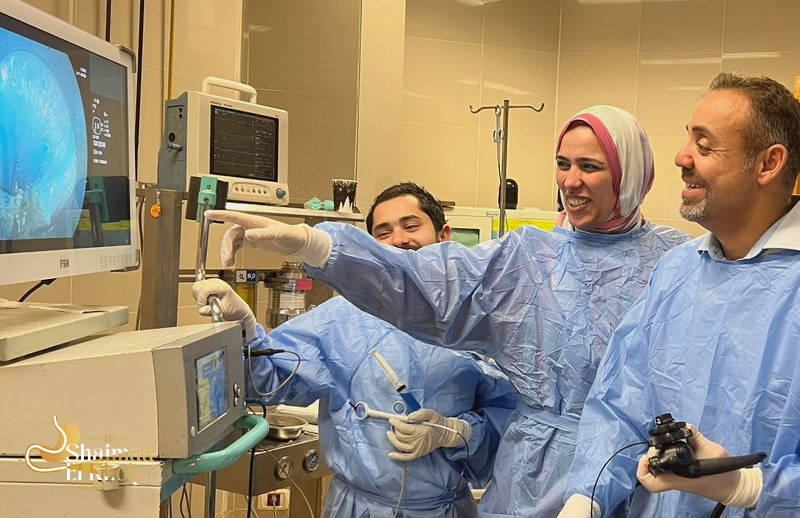
Leveraging techniques developed by Chinese physicians, Dr. Shaimaa El Kholy, Associate Professor of Advanced Interventional Gastrointestinal Endoscopy (ESD & Third Space Endoscopy), introduced Endoscopic Submucosal Dissection (ESD) to the Arab Republic of Egypt in 2018. ESD removes benign, precancerous, and early-stage malignant tumors in the gastrointestinal tract, including the esophagus, stomach, colon, and rectum. During the ESD procedure, the intervention occurs in the third layer of the wall to cut out the tumor while leaving the rest of the gastrointestinal wall intact. Special knives are used to precisely cut and remove the tumor without compromising the integrity of the gastrointestinal wall.
Previously, in cases of esophageal or stomach cancer, the only solution was to remove the esophagus or large parts of the stomach. Naturally, these surgeries have a significant impact on the patient's quality of life.
Endoscopic Submucosal Dissection (ESD) preserves the organs and allows patients to live normally and survive without surgery, as it preserves much more healthy tissue compared to previous treatment options. ESD benefits patients who may not be candidates for surgery, including weak and elderly individuals.
The primary goal of Endoscopic Submucosal Dissection (ESD) is to avoid unnecessary surgery for patients with tumors that can be removed endoscopically. ESD is performed similarly to traditional endoscopic procedures but requires specialized tools and advanced training. Dr. Shaimaa El Kholy, Associate Professor of Advanced Interventional Gastrointestinal Endoscopy (ESD & Third Space Endoscopy), Faculty of Medicine, Cairo University, has received such training and has become a trainer for other doctors in various countries. In 2022, she was invited by the United States to participate in a workshop and training during a major international conference in San Diego, California.